 English
  日本語
日本語  français
  Deutsch
  Español
  italiano
  português
 Search
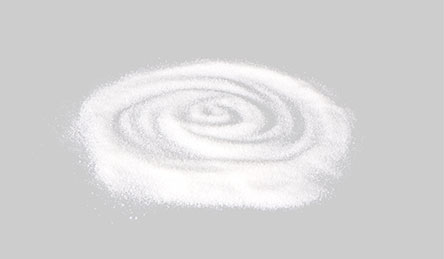
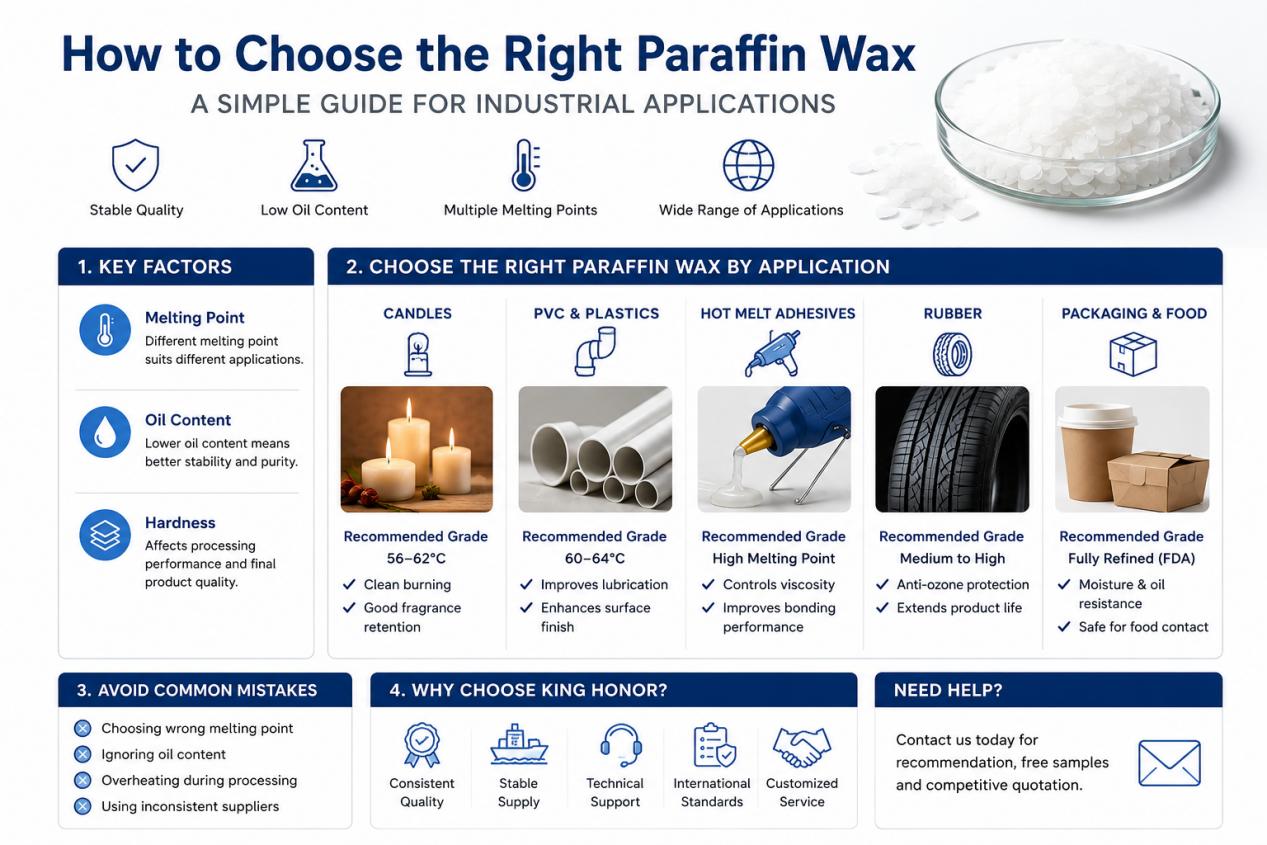
Choosing the right paraffin wax grade is essential for achieving stable product performance, efficient processing and cost optimization. Different applications require different melting points, oil content levels and hardness characteristics.
This guide will help you select the most suitable paraffin wax based on your industrial application.
Before choosing paraffin wax, it is important to understand the main technical parameters:
Melting Point
Low melting point (54–58°C): softer wax, suitable for candles and surface coatings
Medium melting point (58–62°C): balanced performance for general applications
High melting point (62–68°C): harder wax, suitable for industrial processing
Oil Content
Lower oil content provides better stability and higher purity
Fully refined paraffin wax typically contains less than 0.5% oil
Hardness and Structure
Affects processing behavior, surface quality and mechanical strength
These parameters directly influence final product performance.
Recommended grades:
56–58°C for container candles
58–62°C for pillar candles
Advantages:
Stable burning performance
Good fragrance retention
Smooth surface finish
Recommended grade:
Fully refined paraffin wax (60–64°C)
Advantages:
Improves lubrication during extrusion
Enhances surface gloss
Increases processing efficiency
Recommended:
High melting point paraffin wax
Or blended with FT wax for better performance
Advantages:
Controls viscosity and open time
Improves bonding strength
Enhances production efficiency
Recommended:
Medium to high melting point paraffin wax
Advantages:
Forms protective anti-ozone layer
Prevents aging and cracking
Improves durability
Recommended:
Fully refined paraffin wax (FDA compliant grade)
Advantages:
Moisture and oil resistance
Suitable for food contact applications
Improves packaging performance
To ensure stable production, avoid the following issues:
Selecting incorrect melting point grade
Ignoring oil content differences
Overheating during processing
Using inconsistent quality suppliers
Proper material selection is critical for product consistency.
In industrial applications, paraffin wax is sometimes used alone or combined with other waxes:
Microcrystalline wax: better flexibility and adhesion
FT wax (Fischer-Tropsch wax): higher hardness and performance stability
Wax blends: optimized balance between cost and performance
Choosing the right combination depends on your production requirements.
Working with a reliable supplier ensures:
Stable quality across different batches
Consistent melting point and performance
Technical support for application optimization
Reliable long-term supply capability
At King Honor, we provide a full range of paraffin wax grades with stable quality, suitable for chemical, rubber, plastic, packaging and other industrial applications.
If you are not sure which paraffin wax grade is suitable for your application, please contact us with your requirements.
We can provide:
Technical recommendations
Free samples
Competitive quotation within 24 hours